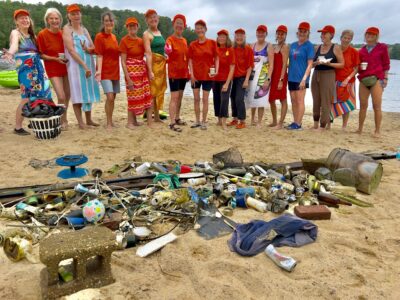

The United States Clean Water Act protects water quality and regulates pollutant discharges into the nation’s waters. It’s the most crucial piece of legislation protecting American citizens from toxic water. Before it was passed, industrial facilities disposed of their chemical waste in streams, lakes, and oceans. Signed into law on Oct. 18, 1972, the Clean Water Act established a basic structure for protecting all bodies of water in the country.

Photo Courtesy National Wildlife Federation
In the early 20th century, growing public awareness and concern for water pollution led to a law known as the Federal Water Pollution Control Act of 1948. It was the first major law in the United States to consider the condition of the nation’s waterways.
At that time, major rivers such as Cuyahoga, Buffalo, and Delaware were so polluted that fish couldn’t survive in them, and the water’s surface even caught on fire due to oil slicks.
“That was happening across the country because of industrialization,” Dominique Lueckenhoff, a senior fellow at the U.S. Water Alliance, said in a U.S. Water Alliance video. “And it was time, right, that a Clean Water Act came to the rescue.”

Photo Courtesy U.S. Water Alliance
Twenty-three years later, the 1948 law evolved into the Clean Water Act. The act has two major parts:
- One for the provisions that authorize federal funding for municipal sewage treatment plant construction and
- The other is for regulatory requirements that apply to industrial and municipal dischargers.
The act also allows the Environmental Protection Agency (EPA) to implement pollution control programs. Some of those programs include the National Pollutant Discharge Elimination System Program, which regulates permits for pipe, ditch, and sewer pollutants into waters, and the Sewage Sludge Use and Disposal Program, which oversees permits for the use and disposal of sewage by land application, incineration, and municipal solid waste landfills. The EPA sets legal limits on more than 90 contaminants in drinking water.

Photo Courtesy EPA
The Clean Water Act also provides funding for sewage treatment plants. Under the Construction Grants program, more than $60 billion has been distributed to build public wastewater treatment projects from coast to coast.
According to the National Wildlife Federation (NWF), under the act’s umbrella, the National Pollutant Discharge Elimination System program prevents 700 billion pounds of pollutants from entering American waters annually.
However, the act does not directly regulate agricultural or urban runoff pollution, such as soil washed-off fields.
The Clean Water Act is working. According to NWF, to date, the act has kept 700 billion pounds of pollutants out of our waters annually, slowed the loss rate of wetlands, and doubled the number of waters safe for fishing and swimming. It also created steps for construction-caused stormwater discharges against Wal-Mart, Target, Pulte, Centex, KB Homes, Richmond Homes, and many smaller developers.
As of 2022, it has funded approximately 35,000 grants totaling $650 billion. On average, each grant significantly decreased pollution for 25 miles downstream, with benefits lasting for decades. The Act continues to help protect the nation’s waters from new threats as they develop and is considered the cornerstone of keeping the U.S. water supply safe and healthy for all.

Photo Courtesy NWF/Kevin McCarthy
“From the Great Lakes to the Chesapeake Bay, wetlands provide wildlife habitat and filter out pollutants, and streams help provide drinking water to millions of Americans,” John Rumpler, Environment America Clean Water director, said in a statement. “Fifty-one years ago, Congress responded to public demand and voted overwhelmingly to protect all of our waterways under the Clean Water Act. With threats ranging from PFAS chemicals to toxic algae, our rivers, lakes, and streams urgently need protection today as well.”