It may be the most perfect example of the melting pot that is the United States of America, yet it may not be the first state that jumps to mind. However, Louisiana has a little bit for everyone.
There is very little that Louisiana doesn’t have to offer, from the long, dry rows of plowed fields in the north to the hot, sticky September college football nights in Death Valley full of people cheering on the Louisiana State University Tigers.
Of course, we can’t forget the boozy, joyful, beer-soaked asphalt of Bourbon Street in New Orleans, grooving to the sounds of one of Black America’s inventions — jazz!
It would likely be no surprise to learn that a state with this much diversity and multiculturalism — ancient Indigenous beginnings, Creole and French influences, and rhythm and blues music mixed with gospel soul handed down from pre-Civil War slave songs — would have quite a story to tell.
Like any good tale, Louisiana has its fair share of heartache and struggle. However, the story of the Bayou State is also one of dogged determination in the face of upheaval and unrest.
Thankfully, many of these great stories can be found by visiting one of Louisiana’s three National Monuments. Read on to learn more!
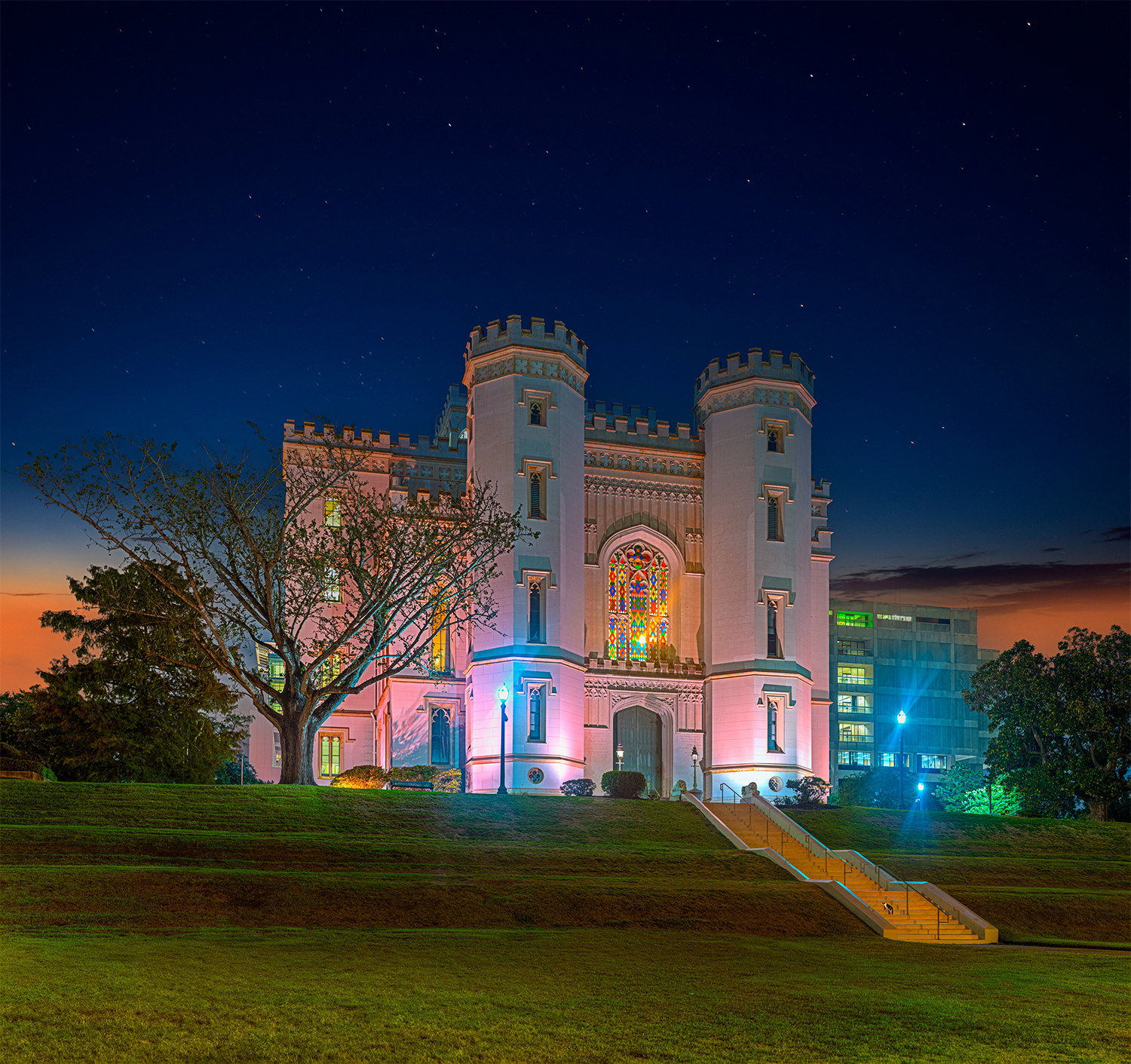
Old State Capitol: If these walls could speak, they’d spin quite a story. This National Monument, located in downtown Baton Rouge, Louisiana, stands as a constant reminder to the people of Louisiana of all the state has weathered: war, fire, and even a good old-fashioned brawl or two. Opening its doors for the first time in 1850, it was from this state house that Louisiana seceded from the Union in 1861 at the start of the Civil War. It also was there that the Union eventually overran and burned the original structure. The building would be rebuilt, and numerous historical events would be seen within its walls, most notably the controversial legacy of Gov. Huey Long, the last governor sworn in on the original grounds. Today, the Old State Capitol tells these stories and many more, giving visitors a glimpse into the inner workings of Louisiana’s governing past.

Photo Courtesy Louisiana’s Old State Capitol
Poverty Point National Monument: This site preserves the legacy of a forgotten civilization that lived and thrived on the delta some 3,000 years ago. Poverty Point, a massive trading operation that stretched outward for hundreds of miles, was a vital area of commerce and engineering on the ancient North American continent. Today, it is one of the most important North American archeological sites in existence. Visitors can learn more about the exceptionally advanced people who lived and built their communities here millennia ago. This monument is a must-visit for lovers of ancient history.

Photo Courtesy NPS
The Katrina National Memorial Park: Like most states, Louisiana’s story is marred by great tragedy throughout its history. However, there may be no more tragic event in the modern era than the aftermath of Hurricane Katrina, which fundamentally changed the landscape of southern Louisiana and, in many ways, national American politics. The massive category five storm, which made landfall in late August 2005, would devastate the area and lead to more than 1,800 deaths, in addition to billions in property loss. The subsequent emergency response and the news coverage that followed over the next few days and weeks would spark new conversations about economic and racial disparities in the U.S. Today, The Katrina National Memorial Park stands in honor of the lives lost and the bitter memories that remain so that this history will be a teacher for future generations.

Photo Courtesy Katrina National Memorial Museum