
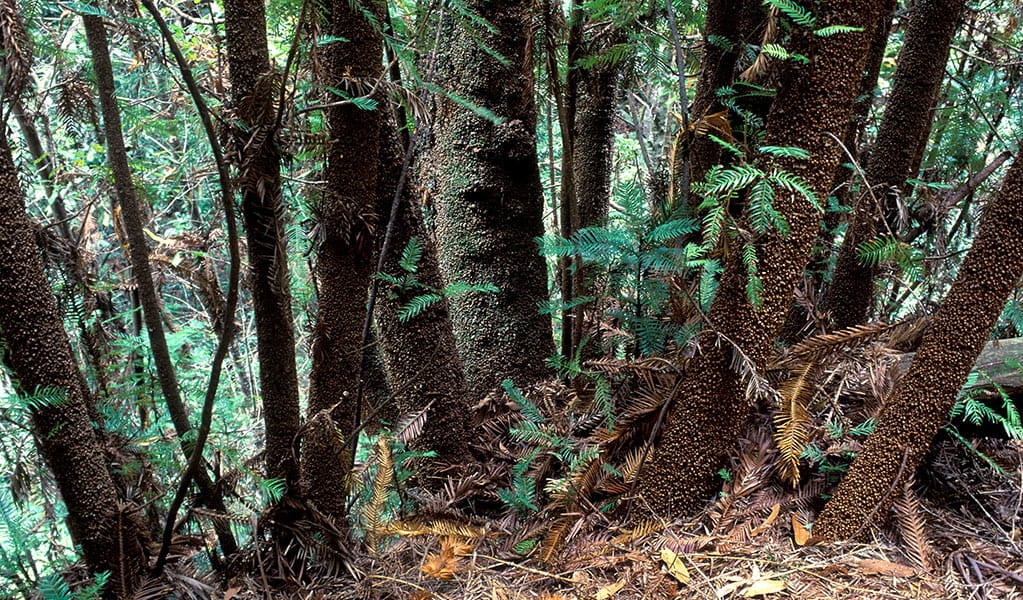
The formerly extinct Wollemi pine is making a secretive comeback in Australia. Scientists once thought the unique conifer species had disappeared from the planet until it was rediscovered in the Blue Mountains near Sydney in 1994.
Over the past 30 years, scientists have been planting small tracts of Wollemi pine in various translocation sites, which are off-limits to the public. The large tree looks prehistoric, with fern-like light green foliage and a uniquely textured bark.

Photo Courtesy New South Wales National Parks and Wildlife Service
“It’s been described as the botanical find of the century,” Dave Crust, Blue Mountains Branch director of the New South Wales National Parks and Wildlife Service (NPWS), told ABC Australia. “The fact that such a small population just remained in this incredibly remote canyon in Wollemi National Park is pretty remarkable.”
The tree evolved 91 million years ago and went extinct 2 million years ago. The 1994 find surprised experts, who discovered a group of 90 specimens high in the remote Blue Mountain peaks. Since then, a team of specialists from the NPWS has been planting small clumps of the Wollemi pine in other locations to help reintroduce the species to the continent. Today, hundreds of the trees grow across three different sites, all offspring of the original intact stand.

Photo Courtesy New South Wales National Parks and Wildlife Service
“Wollemi Pine seedlings and saplings grow less than one centimeter a year,” scientist Berin Mackenzie explained to ABC Australia. “They won’t mature until they can reach the rainforest canopy and access the sunlight above.”
A Wollemi reaches maturity after 30 years, three decades in which they are susceptible to disease and damage. According to the Good News Network, due to the fragile nature of the tree, workers have to decontaminate themselves of any seeds and sanitize their bodies to ensure they don’t bring disease or invasive species into the young trees.
According to NPWS, the trees are particularly at risk for contamination by a microscopic pathogen called phytophthora, or “root rot.” That risk is the main reason the translocation sites are off-limits to the public. In fact, the Australian Biodiversity Conservation Act prohibits unauthorized entry into the sites, which is punishable by up to two years in prison and a fine of $330,000.
“One of the biggest dangers that we have is people actually come and visit these,” Penny Sharpe, New South Wales environmental minister, said to ABC Australia. “We know people want to, but they really can’t.”

Photo Courtesy Penny Sharpe MLC
The Australian government is working hard to ensure the Wollemi’s future. ABC Australia reported that Wollemi pine seedlings have been shipped worldwide to botanical gardens and can be purchased at nurseries as part of an effort to save the species.
“The species was discovered in the nick of time and on the brink of extinction,” Mackenzie told ABC Australia. “We have a really rare and important opportunity here to intervene and help it persist.”